


Why nuclear;
why now?
Why nuclear; why now?
Global SMR momentum is building: more than 50 projects are advancing through licensing across 15 countries, with $15.4bn already invested and 40GW projected by 2050.
Blue-chip corporates are moving early: Microsoft and Amazon backing nuclear-linked energy strategies, Google contracting for firm clean power, and Dow deploying reactors to decarbonise petrochemical production.
The UK is uniquely positioned as Europe’s gateway, with regulatory credibility, capability, and supportive power economics.
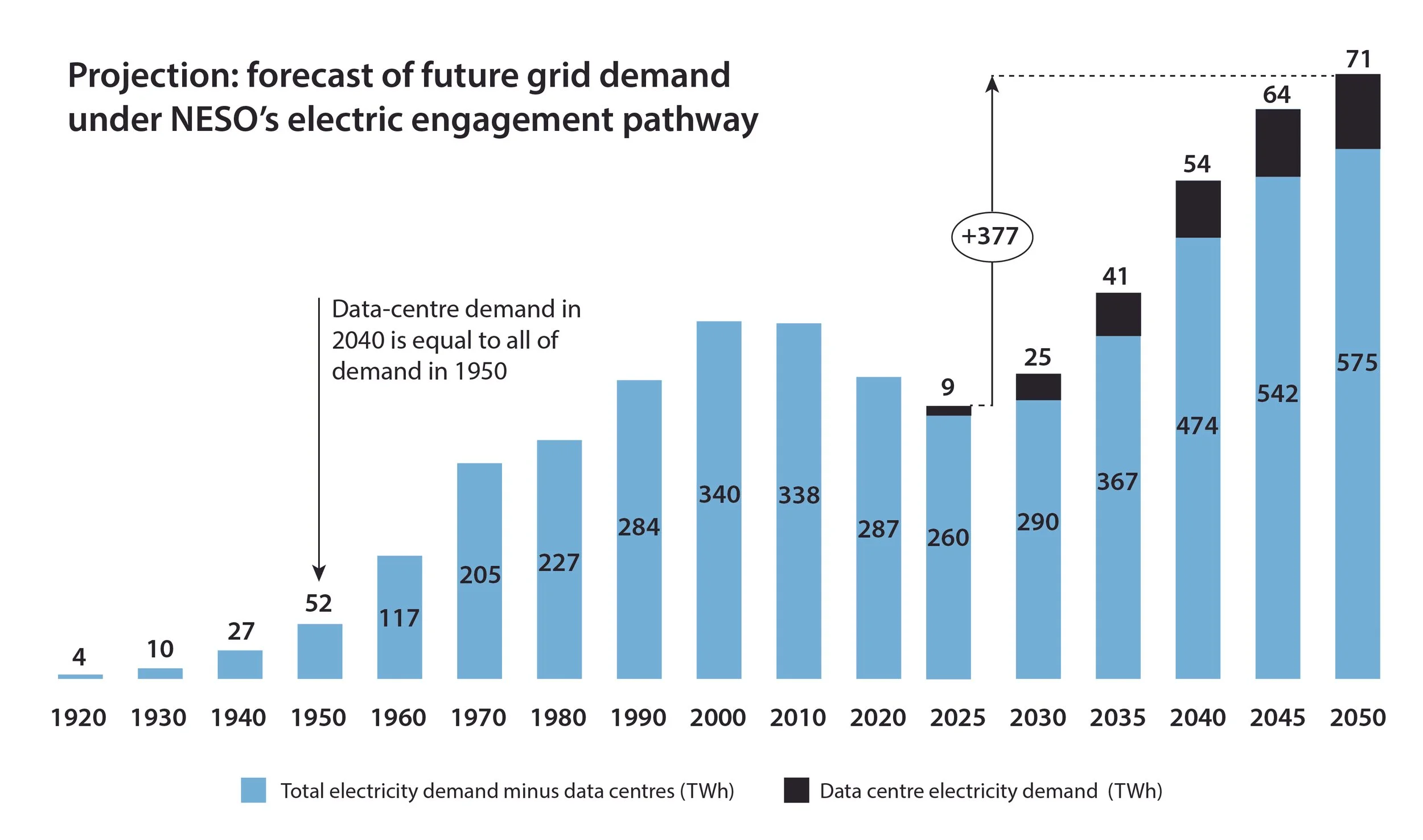
UK electricity demand is forecast to grow 2.0–2.4x by 2050 as transport, heat, and industry electrify. Data centres alone could require up to 71TWh annually — equivalent to roughly one-fifth of today’s total grid demand. This structural expansion necessitates rapid generation build-out, particularly in reliable baseload capacity.
Nuclear offers scalable, clean and dependable supply aligned to industrial and digital growth. Demand is accelerating. Capacity must follow. Nuclear bridges the gap.
The UK Government is committed to achieving (at least) 95 per cent Clean Power by 2030, and nuclear is a cornerstone of this strategy.
Successive UK governments have demonstrated consistent support for nuclear and SMRs. The 2024 Civil Nuclear Roadmap targets up to 24GW by 2050, while the GBE-N SMR competition and £2.5bn backing towards an SMR project signal tangible commitment. The Government has also opened the Advanced Nuclear Framework pipeline process to support the development and deployment of private sector advanced civil nuclear projects.
Some 44 per cent of UK energy is import dependent and around only 18 per cent of total energy demand is supplied with electricity; the remainder comes primarily from combustion of fossil fuels. The need for energy security and low-carbon power is driving electrification across the UK economy. The UK’s National Energy System Operator (NESO) has forecast that electricity demand is expected to grow 2.0-2.4 times from today’s grid capacity, necessitating rapid expansion.
This is a reversal of recent trends that have seen a drop in demand – a consequence of deindustrialisation and push for energy efficiency.
Data centre demand is forecast to increase nearly ten-fold from today’s electricity requirement, to c.10 per cent of total UK electricity demand. This is equivalent to building three new Hinkley Point C power stations, or 21 per cent of today’s total grid.
Quick links to other sections